
What codependency is, how it develops in relationships, why caring can turn into control and rescuing, and how to gradually restore your boundaries and your own life.
Have you ever felt that your entire life revolves around someone else? That you are constantly thinking about what mood they are in, what they are doing right now, whether something has happened to them? That your own wishes, plans, and feelings have somehow moved far into the background?
If you recognize yourself in this, do not rush to diagnose yourself. Codependency is not a sentence and not a sign of weakness. It is a reaction that can develop when you live close to someone whose behavior you cannot control. And it is something that can be worked with.
In this article, we will look at what codependency is, where the term came from, and how to recognize when caring for someone close to you has become a trap — for both of you.
How the Term “Codependency” Appeared
Do you know where this word came from? From self-help groups.
In the 1960s and 1970s in the United States, wives and children of people with alcohol addiction, while attending support groups, noticed something strange: life next to a person who drank also became unmanageable. They felt almost as lost as the addicted person himself. The difference was that he was struggling with alcohol, while they were struggling with an endless sense of guilt, shame, and the urge to control everything around them.
In 1986, the community Co-Dependents Anonymous, or CoDA, was founded. Its members acknowledged their powerlessness not over alcohol, but over another person.
It may sound strange, but the idea was simple: living next to a person with addiction and constantly adapting to their illness can also become a trap that a person needs to find a way out of.
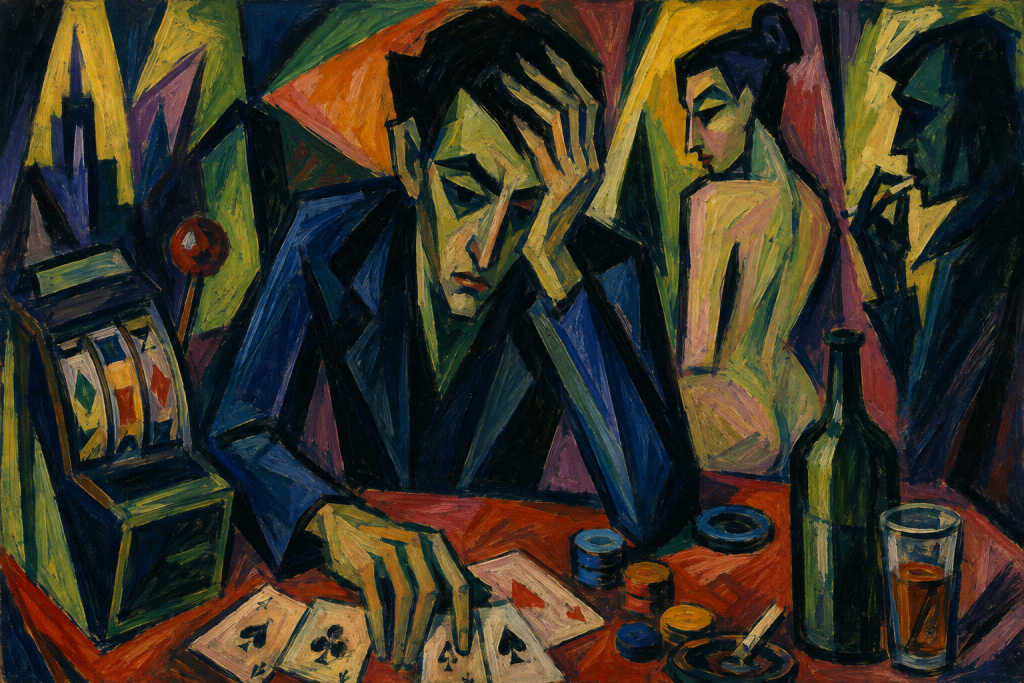
Originally, the term was used mainly in relation to families of people with alcohol addiction. Over time, however, it became clear that similar patterns can develop around anyone whose behavior becomes unmanageable: someone with drug or gambling addiction, disordered eating, or simply a person who is emotionally unstable.
What Codependency Means in Simple Terms
Imagine this.
You are sitting on an airplane. The flight attendant says: “Put your own oxygen mask on first, and then help the child.”
We all know this rule. But in everyday life, we often do the opposite: we first try to save someone else and leave ourselves without air.
Codependency is when you keep giving your oxygen mask to another person. And gradually, you stop noticing that you yourself are suffocating.
In healthy relationships, we are all dependent on one another to some extent — and that is normal. A baby cannot survive without the care of an adult. Adults also need closeness, support, attachment, and warmth. This kind of interdependence is a natural part of healthy relationships.
The problem begins when care gradually turns into obsession. When your thoughts and feelings become completely absorbed by another person. When you can no longer distinguish between their responsibility and your own. When you feel guilty if you are not rescuing, controlling, or solving their problems.
What It Looks Like in Real Life
Imagine a woman we will call Marina. Her husband, Sergey, drinks heavily from time to time.
Every day, Marina checks how many bottles are left in the house. She hides money so that he cannot buy alcohol. She calls him at work to make sure he is not drinking. She wakes up at night to check that he is breathing. She apologizes to neighbors, friends, and relatives. She lies to his boss and says that he has the flu. She takes responsibility for his debts.
It looks like she is caring for him, doesn’t it? She is trying to hold the family together, worries about her husband, and loves him.
But in reality, some of her actions make it easier for his illness to continue. She does not allow him to face the consequences of his own behavior. She protects him from reality — and by doing so, deprives him of the opportunity to fully see how serious the problem has become.
And what is happening to Marina herself?
She has stopped seeing her friends — she is ashamed. She has abandoned her hobbies — she has no time. She left a job she loved because she needed to control her husband. She sleeps badly, eats poorly, constantly has headaches, and has developed shortness of breath and blood pressure problems.
Gradually, she has lost herself.
Her life no longer belongs to her. It belongs to her husband’s illness.
Or consider another story.
Elena is the mother of a 25-year-old son with drug addiction. She keeps giving him money because otherwise he will “disappear.” She pays his debts, hides him from debt collectors, and rescues him after overdoses. She begs him to go to a rehabilitation center, and when he refuses, she cries, threatens him, but continues to give him money.
She repeats this cycle for years.
Every time, she hopes that “this time he finally understood.” Every time, she is disappointed again.
At the same time, Elena barely notices that her own health is deteriorating. She also fails to notice that her daughter — the younger child in the family — has grown up with the feeling: “I don’t matter,” because all of the mother’s attention was always focused on her brother.
How to Recognize Codependent Relationships
Ask yourself a few questions:
- Do you constantly think about what another person is doing, what is happening to them, and what mood they are in?
- Do you feel guilty when you are doing something for yourself instead of dealing with their problems?
- Do you take responsibility for their feelings and behavior?
- Are you afraid to tell them the truth because they may become offended or angry?
- Do you try to control them — checking, monitoring, persuading, threatening?
- Are you tired? Constantly? Simply tired of life itself?
- Do you no longer know what you want for yourself: where you would like to be, with whom, or what you would like to do? Does it feel as if there is less and less of you in your own life?
If you answered “yes” to even several of these questions, it is possible that codependent patterns have developed in your relationship.
There is nothing shameful about this. And it does not mean that you are a bad person.
It means that for a very long time, you have been trying to hold together something that you cannot actually control. And this has gradually exhausted you.
Why This Happens
Codependency rarely appears out of nowhere.
Its roots can often be found in childhood — in a family where a person learned to be “easy” and not to have needs of their own; where caring for others became one of the few ways to receive love; where conflicts were handled through guilt, pressure, or control.
You grew up, but those old patterns may have remained.
And now, without realizing it, you may choose relationships in which you once again have the opportunity to play a familiar role: caring, rescuing, controlling, being indispensable.
This is not your fault.
You simply did not know any other models of relationships. Perhaps there really were no other models around you.
But now, in adult life, it becomes your responsibility.
Because as long as you keep rescuing other people, you do not give yourself a chance to live your own life — and you do not give the other person a chance to face reality and feel the need to change something.
What Happens If Nothing Changes
Codependency is not simply a “personality trait.” It is a persistent pattern of behavior and relationships that, over time, can harm both you and the person you are trying to save.
- You lose yourself. Your wishes, feelings, plans, interests, and health.
- You teach other people that you can be an “endless resource.” Gradually, they stop noticing and respecting your boundaries.
- You create a comfortable environment for the illness. You remove consequences, clear away obstacles, and prevent the person from fully experiencing how much their behavior is damaging their life and relationships.
- You may pass this pattern on to your children. They grow up watching this model of relationships and may later become rescuers themselves — or look for someone who will rescue them.
- You live someone else’s life while your own gradually passes by.
What You Can Try Today
1. Start Noticing
Simply begin noticing the moments when you are once again thinking about another person instead of yourself. When you are rescuing instead of allowing them to face the consequences. When you feel guilty even though there is no objective reason for that guilt.
Notice it — and do not judge yourself.
At the beginning, it is enough simply to start seeing your own familiar pattern.
2. Give Yourself the Right to Pause
You have the right not to answer a phone call immediately.
You have the right to refuse to solve someone else’s problem.
You have the right to say: “I can’t do this right now.”
You have the right to be tired, irritated, or sad — and not explain why.
Your feelings and needs do not become less important simply because someone close to you is struggling.
3. Ask Yourself: “What Do I Want?”
It sounds simple, but many people who have lived in codependent relationships for years genuinely cannot answer this question.
Start small:
“What do I want to eat for dinner?”
“Where do I want to go this weekend?”
“What do I want to talk about?”
“Who do I want to meet?”
“What would I like to do today?”
At first, these questions may feel unfamiliar. But gradually, you begin to reclaim your own life.
4. Stop Constantly Solving Other People’s Problems
This is probably the hardest part.
But if you rescue a person from the consequences of their behavior every time, it becomes much harder for them to learn to take responsibility for themselves.
Allowing another person to face the consequences of their choices does not mean abandoning them or stopping loving them.
Sometimes it simply means no longer doing for them what they are capable of doing — and what they need to do — for themselves.
This is not cruelty. Sometimes facing reality is the first condition for a genuine desire to change.
When It May Be Worth Seeing a Psychologist
If you feel that your life has gone out of control.
If you are constantly anxious, ashamed, or guilty.
If you cannot stop yourself from rescuing and controlling.
If you are exhausted by the fact that your whole life revolves around another person.
If you no longer know what you want for yourself.
Working with codependency is not about becoming “selfish.”
It is about getting yourself back.
It is about boundaries, self-worth, and the right to have a life of your own.
Sometimes doing this alone is extremely difficult because your own inner critic may keep repeating: “You are a bad person,” “You are abandoning them,” “You have to help,” “What if something happens to them?”
This is why working with a psychologist can be important. An outside perspective can help you recognize familiar patterns, separate one person’s responsibility from another’s, and gradually learn to build relationships in which there is space not only for the other person, but for you as well.
Conclusion
Codependency is not a sentence.
It is a story that can be rewritten.
It is a role that you can stop playing.
It is air that you can give back to yourself.
You are not responsible for saving everyone. You do not have to be the perfect mother, wife, or daughter. You have the right to your own life, your own wishes, and your own boundaries.
This is not selfishness.
It is a return to yourself.
If there is someone in your life whose behavior you cannot control, it is important to remember: you cannot change them for them.
But you can change your own behavior, your boundaries, and your relationship to what is happening.
And that is what is truly within your control.
Start with yourself.nce of becoming stable and lasting.
About the author
Author: Irina Medved
Psychologist working with family crises, codependency, and the impact of addiction on family relationships. Helps clients recognize unhealthy family roles and patterns, restore personal boundaries, reduce excessive control and rescuing behavior, and develop healthier ways of interacting with an addicted family member.
Specialist page: Irina Medved