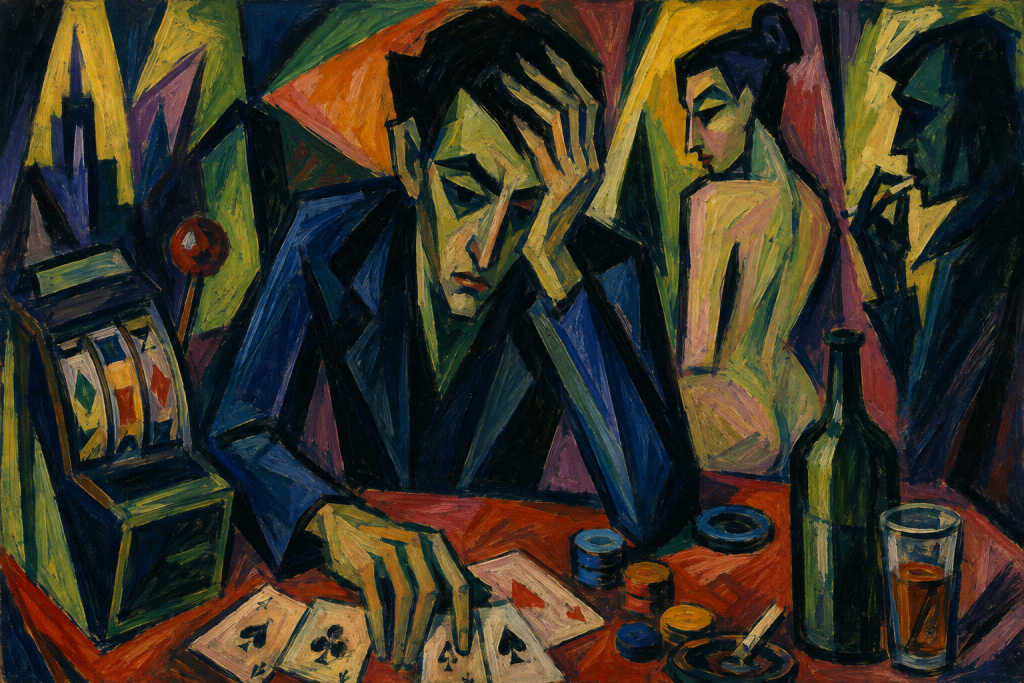

When addiction appears in a family — whether alcohol, drug, gambling, or another form of addiction — loved ones often feel that the problem affects only one person. But in reality, everyone becomes drawn into its orbit. Roles change, plans collapse, and the old rules stop working.
Over time, the family begins to live not its own life, but the life of the addiction. It becomes a resource that allows the addiction to continue. This is not cruelty or weakness — it is love that has unintentionally taken the wrong direction. Addiction in the family affects not only the person with the addiction, but the entire family system.
In this article, we will look at how to recognize this systemic trap, why it can be so difficult for a family to cope on its own, and what first step can realistically begin to change the situation.
Main Signs
You may recognize this situation in your own family if:
- almost every conversation and plan somehow revolves around the addicted person: “How is he today?”, “Will he drink?”, “Has he relapsed again?”
- you constantly feel anxiety, shame, or guilt, even when nothing has happened
- children in the family behave in ways that do not match their age — becoming overly responsible and adult-like or, on the contrary, unusually dependent and immature
- you feel as though you are going in circles: hope turns into disappointment, love into hatred
- you justify the addicted person to others and to yourself, or hide the consequences of their behavior
Why Does This Happen?
Addiction is a systemic, family-related disorder. It affects not only one person but the entire family system. It is useful here to distinguish between two levels.
The first is the immediate family level: parents, partners, and children. At this level, family patterns, attitudes, and beliefs develop and are repeatedly reinforced, shaping the way family members interact with one another.
Each person may unconsciously take on a particular role — rescuer, victim, persecutor. These roles help hold the system together, even when the system itself has become unhealthy. Everyone plays their part in an attempt to preserve balance, often without realizing that this balance is being maintained at the cost of ongoing damage.
The second is the intergenerational level: grandparents and earlier generations. This level can also have its own dynamics, unresolved stories, and trauma that may be passed down over time. We will discuss this separately in future articles.
At the heart of the system are often powerful emotions: pain, resentment, guilt, shame, and a great deal of suppressed anger.
The family can become trapped between hope and disappointment, swinging emotionally from “I will save him” to “I hate him.”
Over time, the family may stop noticing that it has begun to serve the addiction almost as if it were a separate entity. Children’s childhoods, common sense, financial stability, and the future may all be sacrificed on its “altar.”
And this can continue for as long as the addicted person remains attached to the illness.
Why Is It So Difficult for the Family to Cope on Its Own?
It is important to say this clearly: getting out of this cycle without outside help can be extremely difficult.
First, the family is often in a blind spot. When you are inside the system, you cannot easily see it as a whole. You become accustomed to the roles, the tension, and the constant background anxiety.
You stop noticing what has become “normal” because it is part of everyday life. From the outside, patterns can be visible that are almost impossible to recognize from within.
Second, the toxins of the illness gradually distort perception. The family may no longer remember what it is like to live differently.
It is similar to spending a long time in stale air: eventually, you stop noticing the smell and begin to assume that this is simply how things are.
Arguments, relapses, promises, and disappointments begin to feel like ordinary life.
But this is not simply life. It is life organized around the illness.
Third, the family often lacks effective tools.
Intuitive attempts to help — persuasion, control, threats, tears — may end up reinforcing the addiction because they are based on the same old rules of interaction.
To step outside the system, new rules are needed. It can also be helpful to have someone with a fresh perspective and clear judgment who is not emotionally involved in the family dynamics and can see what the people inside the situation cannot.
What Can You Try on Your Own?
You are not powerless or helpless.
Different family members may also be involved in “rescuing” the addicted person to different degrees.
Before seeking professional help, the family can begin with a few first steps.
The key idea is this: supporting a person does not mean supporting their illness.
1. Accept That You Cannot Control the Drinking, Drug Use, or Gambling
You cannot force another person to stop drinking, using drugs, or gambling.
That is their choice and their responsibility.
2. Stop “Rescuing”
Do not automatically pay their debts, lie to their employer, or remove the consequences of their behavior.
This is not cruelty — it means removing the protection that allows the illness to continue without consequences.
3. Talk About Feelings, Not Only Facts
Instead of saying:
“You were drinking again”
you might say:
“I feel afraid and angry when I see you in this state. I cannot continue living like this.”
4. Begin Restoring Your Boundaries
Bring back the parts of your life that addiction may have consumed first: routine, hobbies, friendships, and personal interests.
5. Find Support for Yourself
Look for a support group for relatives of people with addiction, a psychologist, or a community where your experience will be understood.
Dealing with this situation alone can be very difficult.
When Should You See a Psychologist?
It may be time to seek help if:
- you feel that your life is completely controlled by the condition of the addicted person
- tension in the family is increasing and children are suffering or beginning to copy unhealthy behavior
- you are losing your sense of self and no longer know what you want apart from “I just want him to stop”
- attempts to negotiate or increase control have failed for months
- you experience guilt, shame, fear, or emotional emptiness every day
What Can Work With a Psychologist Look Like?
One of the tools that may help initiate the recovery process is family intervention.
This is a structured meeting in which family members, with the support of a professional, speak openly and safely to the addicted person about their feelings, the consequences of the person’s behavior, and the changes the family is prepared to make.
It is not an attack and it is not an everyday ultimatum.
It is a way of saying:
“We love you, but we will no longer support your illness.”
A family intervention is a structured way of giving the addicted person feedback about how their behavior affects other family members.
It should not be confused with an ordinary family argument. A family intervention has a procedure, structure, boundaries, and clear rules — and that is what can make it a therapeutic tool.
More broadly, therapy looks at the family as a system. We do not view the addicted person in complete isolation from their relatives — we also work with what is happening around them.
Together, it is possible to:
- recognize the hidden roles you play and the family patterns you continue to maintain
- learn to separate the person from the illness — to love the person without supporting the addiction
- see which of your actions, even when motivated by good intentions, may reinforce the illness
- find ways to create conditions in which the addicted person has to make their own choices
It is important to understand that only the addicted person can begin their own recovery process.
The family cannot recover on their behalf.
But the family can create an environment in which the illness is no longer comfortable or beneficial. This can give the addicted person a real opportunity to make a different choice.
Conclusion
Addiction is not a sentence for the entire family, but it is a challenge that requires familiar rules to be reconsidered.
Loving a person who is ill does not mean that you must destroy yourself or your children for the sake of their illness.
Real love means supporting the person while refusing to support the addiction.
It can be extremely difficult for a family to change these patterns alone. The blind spot may be too large, and habitual patterns may be deeply rooted.
Sometimes a guide is needed — someone who can see the system from the outside and help the family take the first step.
It is not easy, but it is possible.
And in the following articles, we will continue exploring this topic in more detail.
About the author
Author: Irina Medved
Psychologist working with family crises, codependency, and the impact of addiction on family relationships. Helps clients recognize unhealthy family roles and patterns, restore personal boundaries, reduce excessive control and rescuing behavior, and develop healthier ways of interacting with an addicted family member.
Specialist page: Irina Medved